An Unconventional Alarm Clock
Three versions of an increasingly unreasonable system for getting me out of bed.
The real bug is the morning
Waking up is not always difficult. Eh, maybe I’m lying.
I guess what I mean is that if I am looking forward to something, it is substantially easier. More often than not, however, there is work to be done. Regardless of whether I hate the idea of doing it, the work remains inconveniently existent.
Thanks to Steve Jobs’s revolutionary vision, I own an iPhone. More accurately, thanks to my mom and dad, who financed it. Serendipitously, one of its base features is an alarm clock. Man, is it awesome.
Awesomely inconsistent. But that is likely less an indictment of Apple and more an indictment of the person who keeps turning it off.
So there must be a better alternative to waking up. Cretinously, I decided to be performative, purchasing a poster about discipline.
It looks great on my wall. I hung it up, admired my improved character, plopped back into bed, and woke up around 10:00 a.m. the next morning.
I think it’s safe to assume the poster didn’t help, although the Amazon reviews were overall positive.
I guess the consensus I arrived at was that most alarms make noise. They also expect the person in bed to cooperate.
I needed an alarm with an escalation policy.
Version 1: Salvaging the blaster
Around this time, I was reading two books I would recommend to anyone interested in electronics: The Art of Electronics and Practical Electronics for Inventors. Credit for the second recommendation goes to my dad.
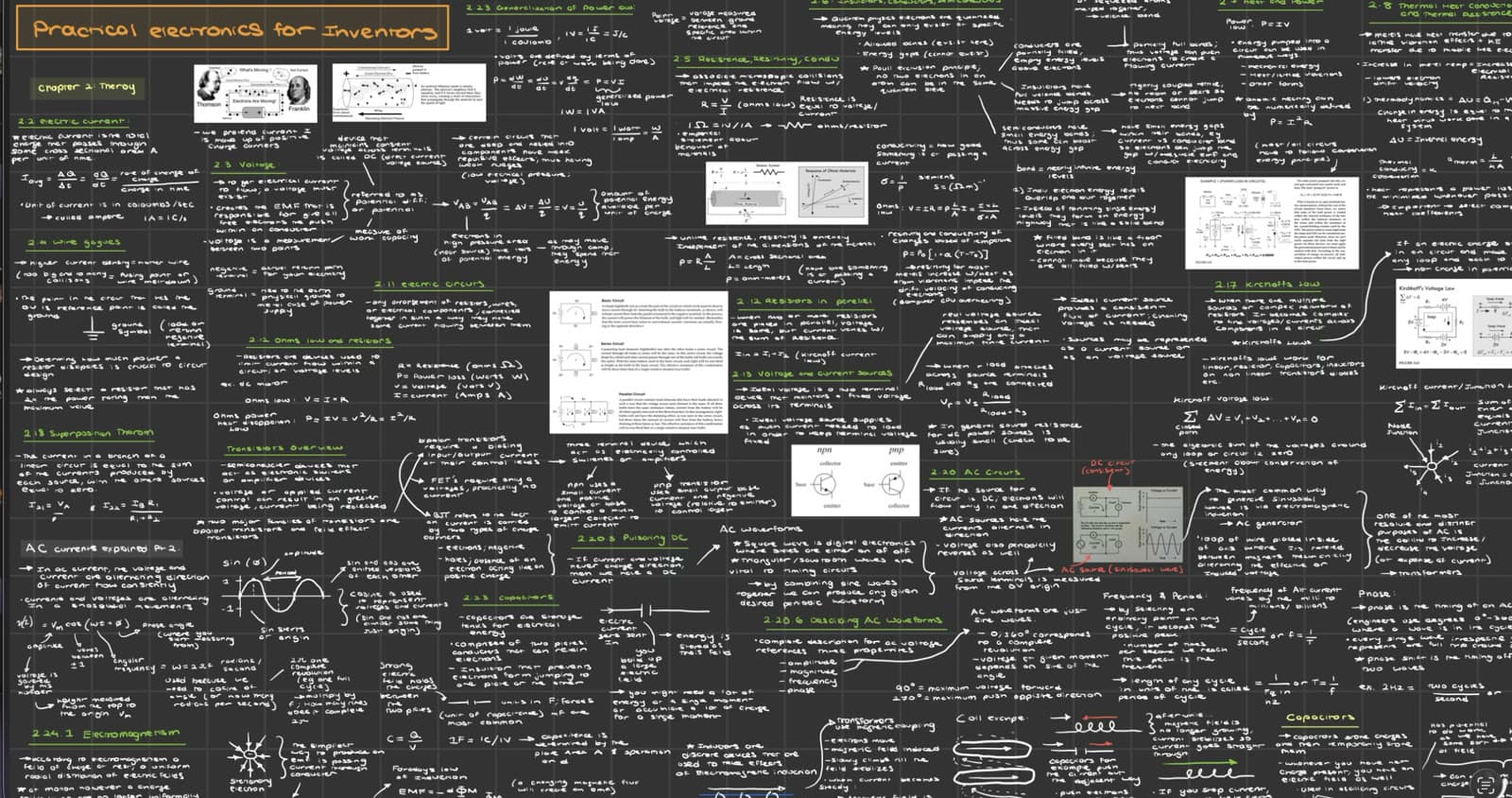
I was also rummaging through electronics he had stored in the garage, searching for parts.
That is where I found an old gel blaster.
A few neurons fired in an orthogonal direction. Minutes later, the blaster was in my room and in pieces.
Inside, I found a 3.7V 2200mAh battery, several switches, a small brushed DC motor, and the original feeding and firing mechanisms. I removed most of the control electronics, reducing the blaster just enough to drive the motor. Whether the remaining mechanism still worked was unresolved.
To validate it, I used an L298N motor driver. The L298N is inexpensive, convenient, and a remarkably effective miniature hand warmer. For this prototype, it was sufficient.
About 10 minutes later, the motor spun.
I promise I am not a masochist. Yet I found myself strangely excited to test a machine whose purpose was to shoot its creator. The excitement was brief.
The motor and firing mechanism worked, but the original cartridge could no longer feed gel rounds consistently into the chamber. And so a new mechanical constraint was introduced.
Repairing the cartridge would likely mean reconstructing its internal feeding mechanism. Worse, designing a replacement in CAD. To avoid exacerbating the situation, I inverted the blaster and converted it into a gravity-fed system. A pink plastic boba straw constrained the ammo above the chamber, while Gorilla Glue fixed the guide in position.
The assembly was crude, but the rounds fed consistently.
Newton spared me from opening CAD.
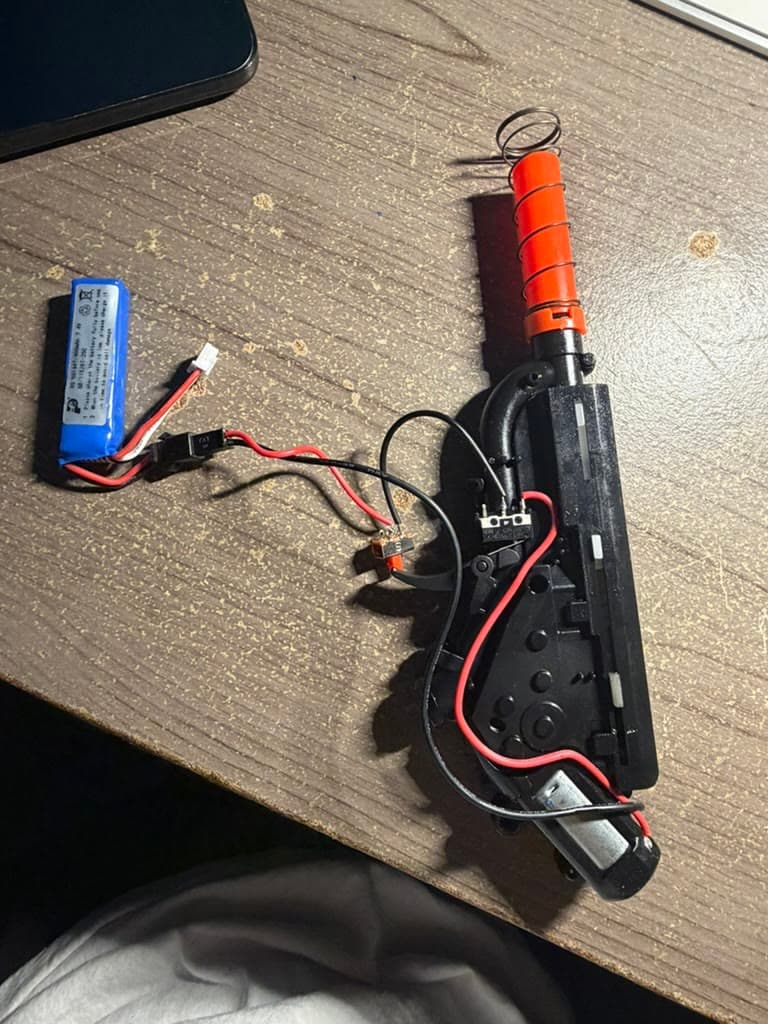
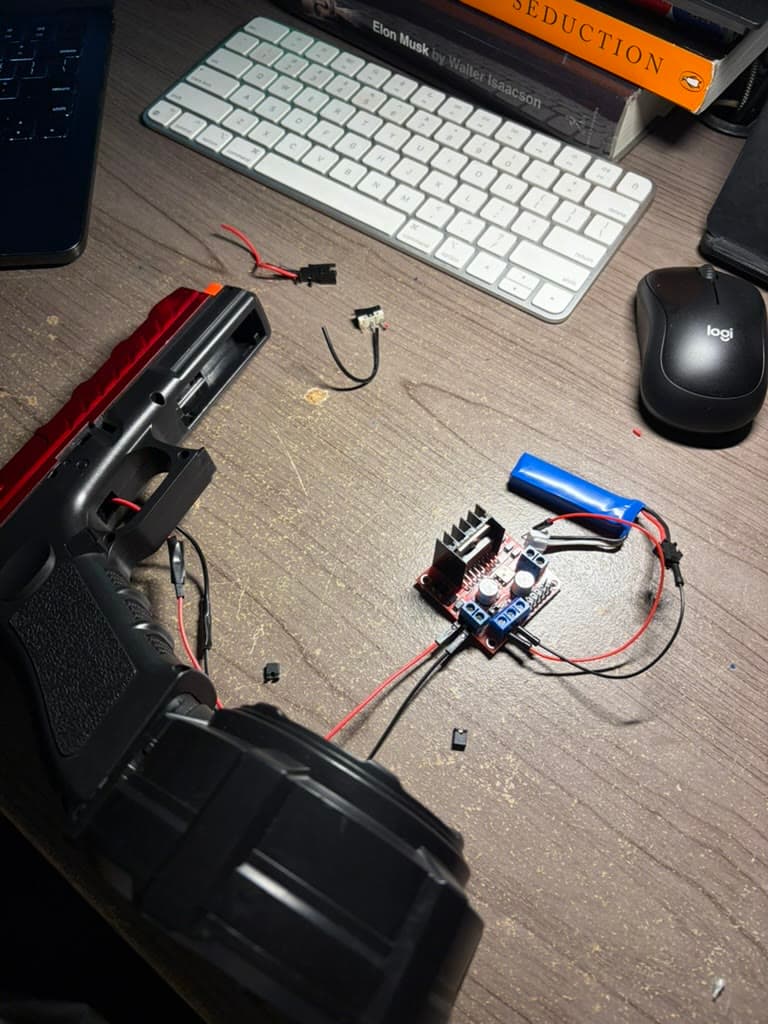
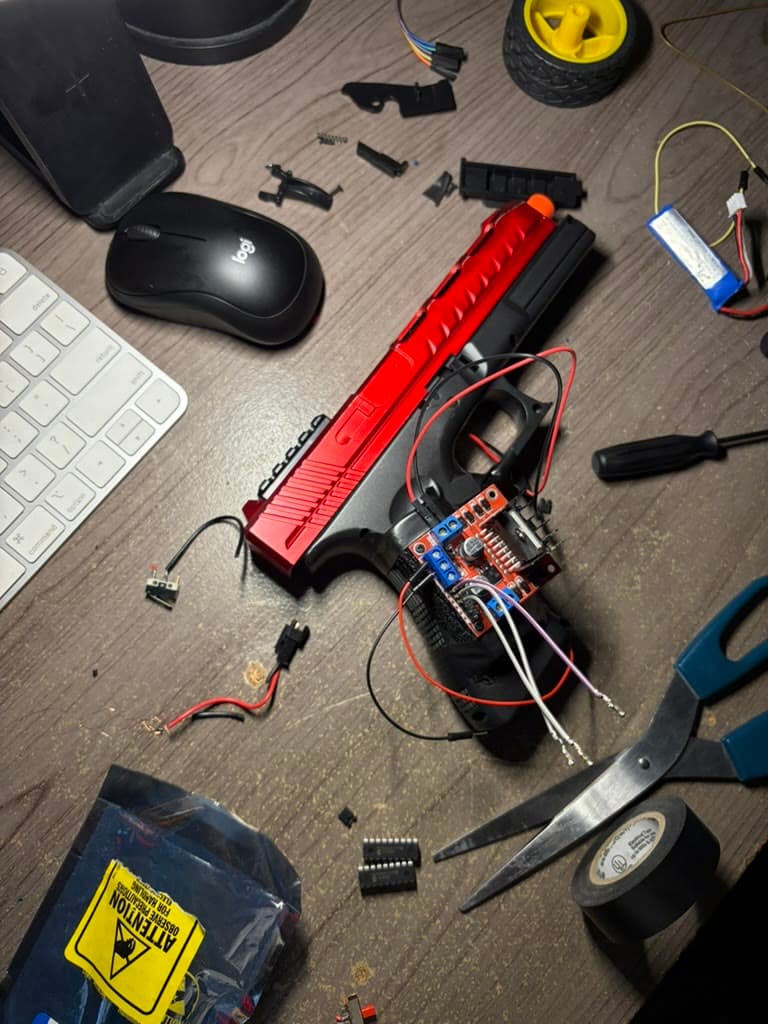
Version 1 proved that the mechanical system still worked. What it could not do was wake me up by itself.
For that, the blaster needed a clock, a network, and considerably worse judgment.
Version 2: Giving the alarm a brain
Version 2 turned the mechanical prototype into a distributed alarm.
The basic chain looked like this:
Cron schedule → Raspberry Pi → RF-controlled outlet → ESP32 → UDP instruction and local countdown → MOSFET switch → gel blaster
For nontechnical readers
The objective is relatively straightforward. Remove what I did not need, keep the motor and firing mechanism, and make the remaining components controllable.
For my technical readers
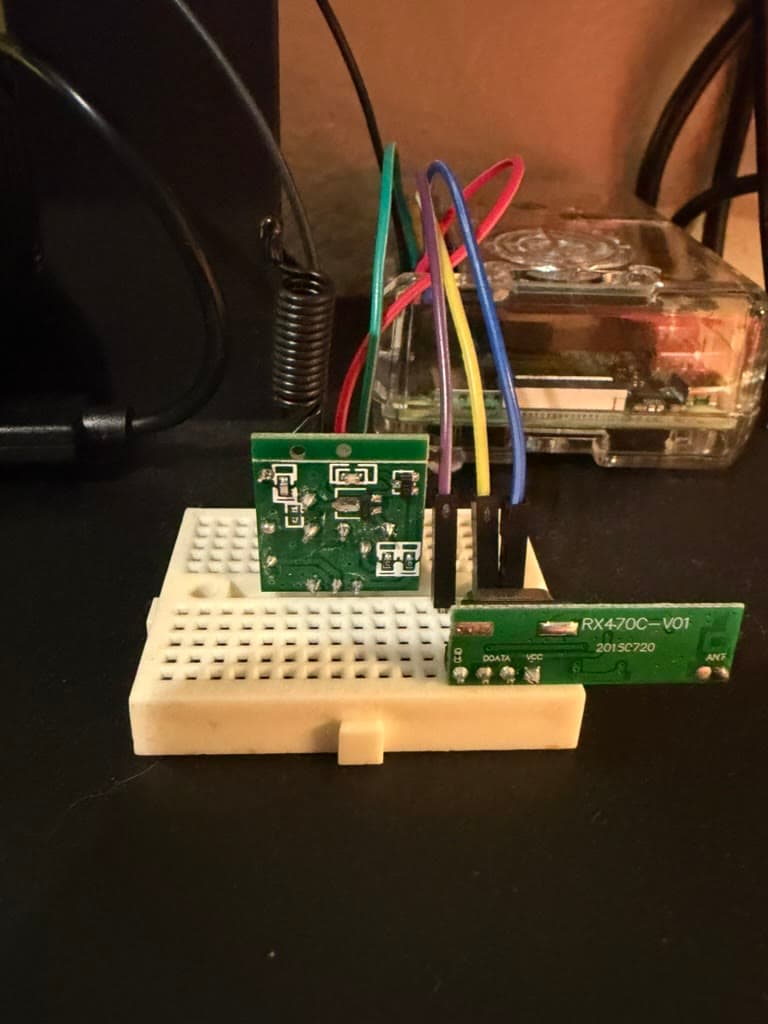
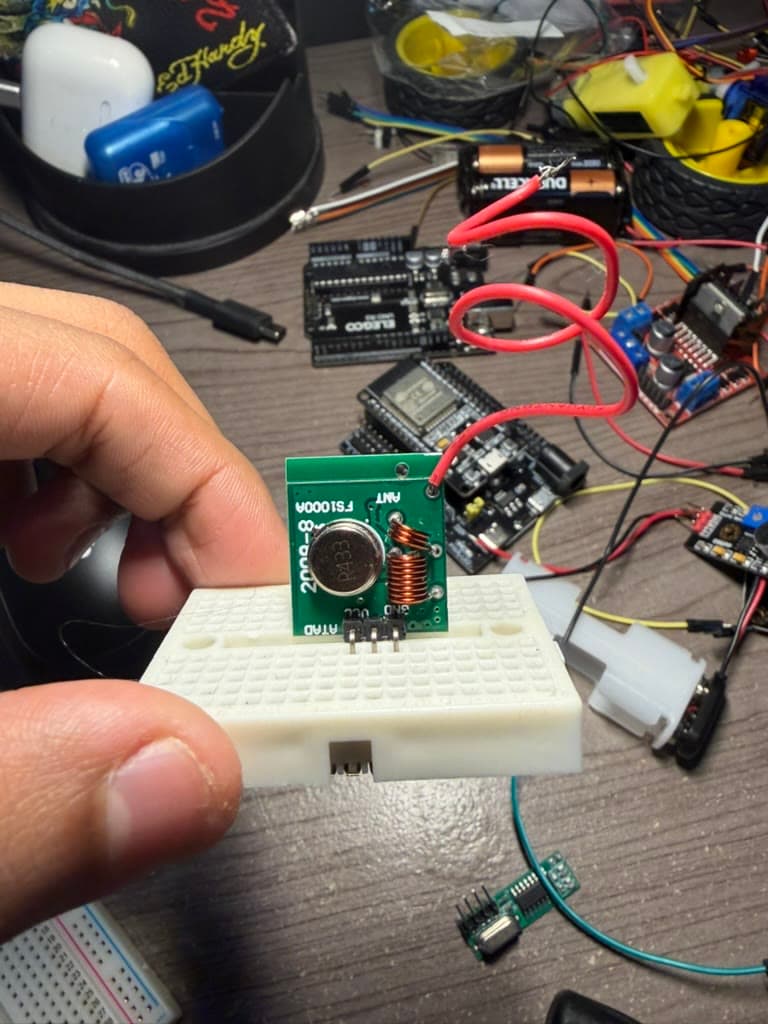
The Raspberry Pi owned the schedule, but it controlled the system’s power indirectly. I connected an FS1000A transmitter and RX470C receiver through its GPIO pins, then soldered on makeshift antennas salvaged from old RC-car parts.
The modules operated at 433 MHz. I used the receiver to capture the wireless outlet remote’s on-and-off pulse patterns. I replayed those codes through the FS1000A so the Pi could control the outlet.
That RF connection was one-way, however. The Pi could transmit an instruction but received no confirmation that the outlet had switched. My original implementation sent the 433 MHz command, waited for an interval, then transmitted an activation command over UDP.
If the outlet failed to turn on, or the ESP32 was still booting and joining Wi-Fi, the packet disappeared.
The simple fix was separating orchestration from actuation.
The Pi initiated the outlet sequence early, giving the ESP32 time to power on and join Wi-Fi. Once the UDP command arrived, the ESP32 owned the final countdown and triggered the XY-MOS locally.
Not every nail requires a nail gun. The ESP32 was the hammer closest to the nail.
The XY-MOS also replaced the L298N. Because the motor only rotated in one direction, the dual H-bridge contributed unnecessary voltage loss and heat.
The Pi served the scheduling interface over my private Tailscale network. To prevent half-asleep shutdowns, the system generated a random shutdown credential each night, stored only its SHA-256 hash, and discarded the plaintext value.
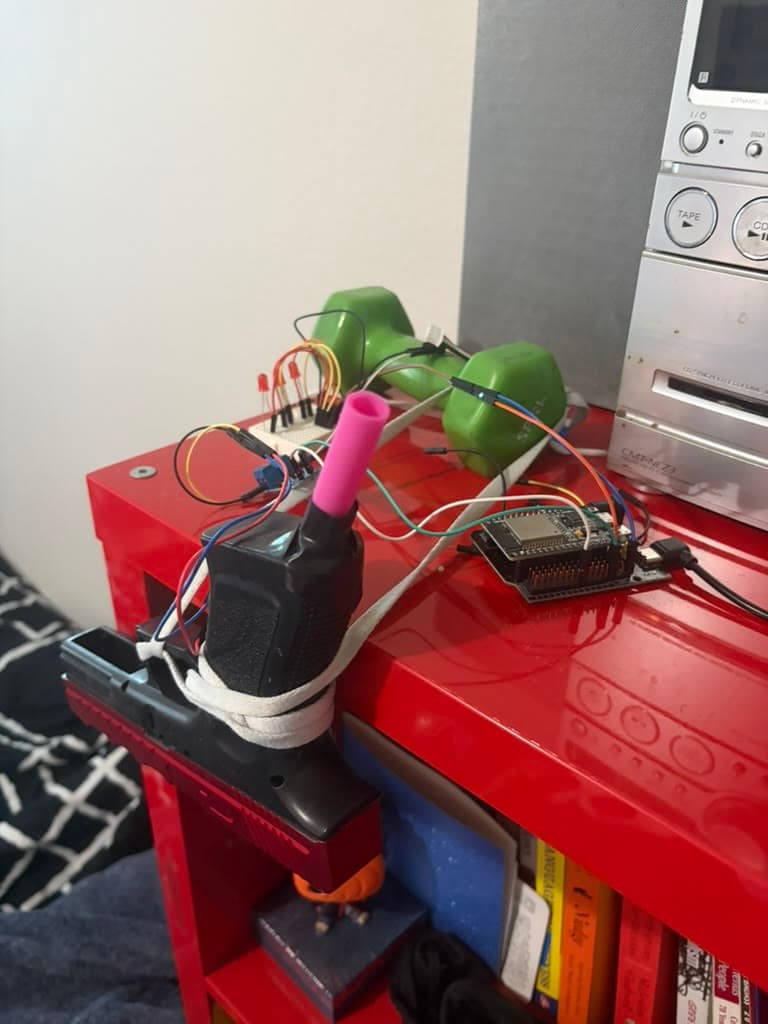
After the timing change, it worked.
On multiple mornings, the outlet powered on, the ESP32 booted, the packet arrived, the countdown expired, and the blaster fired.
And I woke up. Oh boy, did I wake up.
In fact, I eventually started waking up early just to unplug the outlet before the sequence began.
Self-inflicted? Entirely.
Unconventional? Definitely.
Did it work? Absolutely.
Version 3: An unlicensed defense contractor
Version 3 is still being implemented, and the first major change is mechanical.
I have been working with 3D printing and built a planetary gearbox around a NEMA 17 stepper motor. The gearbox is part of a rotating platform for the next version of the system.
If you are looking at that mechanism and thinking what I am thinking, you can probably infer the direction. Version 1 made the blaster fire. Version 2 made it fire on a schedule. Version 3 asks what happens when the system can turn, observe, and coordinate more than one device.
The longer-term plan includes a Raspberry Pi control layer, private connectivity through Tailscale, DNS-level controls, several locally processed camera views, and physical outputs that can interrupt me when I am not doing what I said I would do.
At some point, an alarm clock becomes an autonomous systems project. Version 3 is where I gleefully appear to be crossing that line.
For now, consider this the sneak peek.
Update: The sequel is here: An Unconventional Alarm Clock Goes Autonomous: Pt 2.